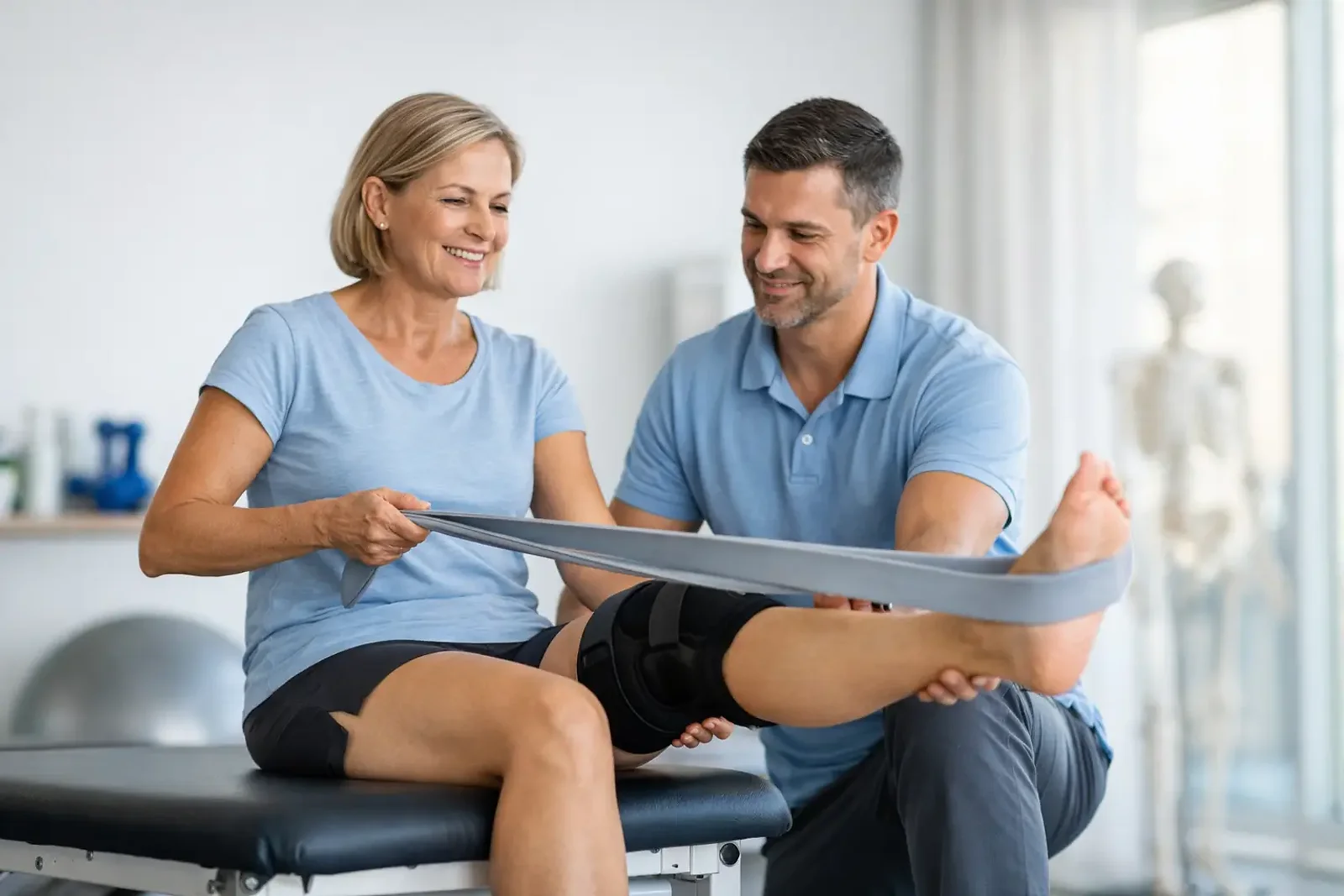
The first few weeks after a knee operation can feel surprisingly uncertain. Even when the surgery has gone well, many people are left wondering whether they should be pushing on, resting more, or doing something in between. The best exercises after knee surgery are not simply the hardest ones or the ones you found online. They are the right exercises for your stage of healing, your operation, and the way your knee is responding day by day.
That matters because knee rehabilitation is rarely a straight line. Some stiffness is expected. Some swelling is normal. A little discomfort during exercise can be acceptable. But more is not always better, and trying to rush strength or mobility too early can slow things down rather than speed them up.
What makes the best exercises after knee surgery?
The best exercises after knee surgery usually do three jobs. They help reduce stiffness, they wake the muscles back up, and they rebuild confidence in walking and daily movement. Which one matters most will depend on the type of surgery you have had.
For example, someone after a total knee replacement often needs to focus early on knee straightening, bending, swelling control and walking pattern. Someone after an ACL reconstruction may need a more carefully staged programme that protects the graft while restoring muscle control. After an arthroscopy or meniscal procedure, the timeline can vary depending on exactly what was done inside the joint.
This is why generic exercise sheets can be a useful starting point, but they should not replace expert assessment. A knee that is hot, swollen and struggling to straighten needs a different approach from one that is moving well but lacks strength.
The early phase - movement and muscle activation
In the first phase after surgery, the goal is usually to restore gentle movement and prevent the muscles around the knee from switching off. One of the most common early problems is inhibition of the quadriceps, the large muscle group at the front of the thigh. If that muscle is not working properly, walking, stairs and confidence can all suffer.
Ankle pumps
Ankle pumps are simple, but they are useful in the very early stage. Moving the ankle up and down helps circulation, especially when you are spending more time sitting or lying down. They are not a glamorous exercise, but they support recovery and are often well tolerated even when the knee is sore.
Knee extension work
Getting the knee fully straight is often one of the highest priorities. This may involve resting the heel on a cushion or rolled towel and allowing the knee to gently straighten, or performing a static quadriceps contraction with the knee supported. Many people focus only on bending the knee, but extension is just as important for a normal walking pattern.
Heel slides
Heel slides are one of the most common early exercises for regaining bend. Lying on your back or sitting supported, you gently slide the heel towards you to increase knee flexion, then return to the starting position. The movement should be controlled rather than forced. Mild tightness is expected, but aggressive pushing can irritate the joint.
Static quadriceps contractions
Tightening the thigh muscles with the leg straight helps restore muscle recruitment. Early on, this can feel harder than expected. That is normal. The key is quality rather than effort alone. A strong, clear contraction is more useful than repeated half-hearted attempts.
Straight leg raise
Once you can tighten the quadriceps well and keep the knee straight, a straight leg raise may be appropriate. This helps build early control through the hip and thigh. If the knee bends during the lift, it is often a sign that the quadriceps are not yet ready for that step.
Building towards normal walking and daily function
As pain settles and swelling becomes more manageable, rehabilitation usually moves on to weight-bearing control and functional strength. This stage is often where people feel better and are tempted to do too much. The challenge is to progress, but not jump ahead.
Supported weight shifts and standing control
Simply learning to put weight through the operated leg confidently is a key milestone. Supported weight shifts, standing balance work and controlled transfers from sit to stand can make a real difference. These help retrain the brain as much as the knee. After surgery, it is common to unconsciously offload the operated side.
Sit to stand
This is one of the most practical exercises in knee rehabilitation because it directly links to daily life. Rising from a chair works the quadriceps, glutes and overall lower limb control. The height of the chair matters. Starting from a higher seat is often more appropriate before progressing lower.
Mini squats
Mini squats can be very effective when introduced at the right time. They develop strength through a manageable range and help with control around the knee and hip. They should be smooth and pain should stay within acceptable limits. A sharp increase in swelling later that day is usually a sign the load was too much.
Step-ups
Step-ups are excellent for rebuilding confidence with stairs and single-leg control. The height should be modest to begin with. A small step done well is far more useful than a larger step done with wobbling, compensation or pain.
The best exercises after knee surgery for strength
Once the knee is tolerating more load, strengthening becomes more important. This phase is often the bridge between basic recovery and getting back to normal activity, work demands or sport.
Calf raises
Calf strength is often overlooked, yet it plays a major role in walking, balance and pushing off the ground. Double-leg calf raises are a sensible starting point before progressing to single-leg work if appropriate.
Bridges
Bridges strengthen the glutes and hamstrings, which help support the knee during everyday movement. They are particularly useful for patients who have become generally deconditioned after reduced activity.
Resistance band work
Simple resistance exercises for the quadriceps, hamstrings and hips can be very helpful at this stage. Hip strength matters more than many people realise. Poor hip control can alter knee alignment and increase strain during walking, stairs and exercise.
Stationary bike
A static bike is often one of the best ways to improve knee motion and general conditioning with relatively low impact. Timing matters, though. It is only suitable once enough bend has returned and your clinician is happy with the stage of healing. For some people, the bike comes in quite early. For others, it needs to wait.
What to avoid
There are a few common mistakes that can slow progress. The first is doing too little for fear of damaging the knee. The second is doing too much because the knee feels better for a day or two. Both can be unhelpful.
High-impact activity, deep loaded bending, twisting or pivoting movements, and unsupervised gym exercises may be inappropriate in the early to mid stages, depending on your surgery. Even useful exercises can become a problem if the dose is wrong. If your knee becomes more swollen, more painful, or noticeably stiffer after exercise and does not settle, your programme may need adjusting.
Pain is not always a stop sign, but it should be listened to. A mild increase in discomfort during rehab can be normal. Persistent worsening pain, night pain, significant heat, calf symptoms, or a sudden drop in function should be reviewed promptly.
Why personalised rehabilitation matters
Two people can have the same operation and recover very differently. Age, previous activity level, pain sensitivity, muscle strength before surgery, swelling response and confidence all influence progress. So do work demands. A teacher, builder, runner and office worker may all need different rehabilitation priorities even if the operation was similar.
That is why expert assessment is so valuable after knee surgery. It helps answer the questions that standard advice cannot. Is your knee bending enough for this stage? Is extension being lost? Is the quadriceps firing properly? Are you loading the leg evenly? Are you ready to progress, or are you compensating?
At Atlas Physiotherapy Clinic, post-operative rehabilitation is built around exactly those questions. Rather than handing over a generic sheet and hoping for the best, the focus is on personalised treatment plans that match your surgery, symptoms and goals.
When to seek extra help
If your recovery feels slower than expected, that does not necessarily mean something has gone wrong. It may simply mean the programme needs refining. Physiotherapy can be especially helpful if you are struggling with stiffness, swelling, limping, poor confidence on stairs, delayed strength gains or uncertainty about what is safe.
Many people also benefit from reassurance. Knowing what is normal, what needs watching, and what the next stage should look like can reduce a great deal of anxiety. Clear direction often makes rehab feel more manageable.
The best exercises after knee surgery are the ones that move you forwards without aggravating the joint. That usually starts with simple movement and muscle activation, then builds into strength, balance and functional control. If you are unsure whether your knee is progressing as it should, getting the right advice early can make the whole recovery feel clearer, steadier and far less frustrating.
Written by
Connor Jayes
Chartered physiotherapist · HCPC PH110273 · Atlas Physiotherapy Clinic, Faversham