If you are weighing up shockwave therapy vs acupuncture, you are probably not looking for a history lesson. You want to know which one is more likely to help your pain, how it feels, how quickly it works, and whether it is worth your time and money.
That is the right way to approach it. These are two very different treatments, and the better choice depends far more on the condition being treated than on what sounds more appealing. In clinic, the key question is rarely, “Which treatment is best overall?” It is, “Which treatment is most appropriate for this tissue, this stage of irritation, and this person’s goals?”
Shockwave therapy vs acupuncture: what is the difference?
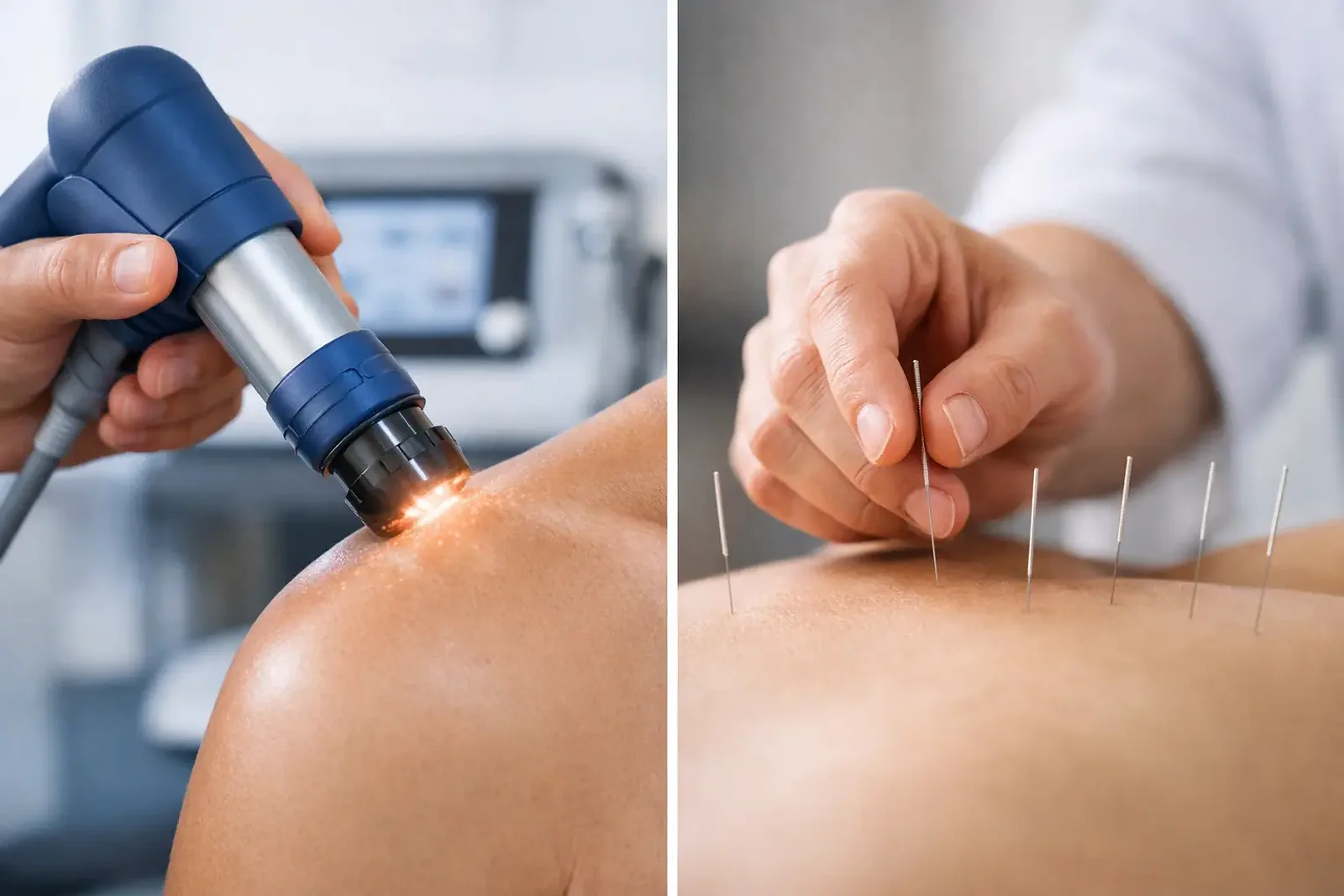
Shockwave therapy uses acoustic waves delivered through a handheld device to target a specific painful area. In musculoskeletal practice, it is most often used for stubborn tendon problems and some soft tissue conditions that have not settled with rest, exercise or manual therapy alone. The treatment is local, focused and based on the idea of stimulating healing and reducing pain in tissues that have become slow to recover.
Acupuncture involves placing very fine needles into specific points in the body. In physiotherapy, it is often used as a pain-modulating treatment to help reduce muscle tension, calm irritated tissues and create a window where movement and rehabilitation feel easier. Some patients come in expecting it to “fix” the problem on its own, but in most musculoskeletal cases it works best as part of a wider treatment plan.
So while both may be used for pain relief, they do not do the same job in the same way. Shockwave therapy is usually chosen for a defined tissue problem, particularly chronic tendon pain. Acupuncture is more often selected to help settle pain, reduce sensitivity or relax overactive muscles.
When shockwave therapy is often the better option
Shockwave tends to come into its own when pain has become persistent and localised. Classic examples include plantar fasciopathy, Achilles tendinopathy, patellar tendinopathy, tennis elbow and some cases of gluteal tendinopathy around the outside of the hip. These are conditions where the tissue itself may need a stronger stimulus to restart recovery.
For the right patient, shockwave can be very effective. It is especially useful when symptoms have dragged on for months and loading programmes alone have not been enough. It can also be a good option for people who want to avoid more invasive treatment and would prefer to try a structured conservative approach first.
There are trade-offs. Shockwave is not usually a relaxing treatment. It can be uncomfortable during the session, particularly over a highly sensitive tendon. That does not mean something is wrong, but patients should know it is often more intense than acupuncture. It is also not suitable for every painful area. If the problem is more about widespread muscle tension, referred pain or a very irritable nervous system, shockwave may not be the best fit.
When acupuncture may be more appropriate
Acupuncture can be particularly helpful where pain is being driven by muscle spasm, protective tension or a sensitised pain system. Neck pain, back pain, tension headaches, shoulder tightness and some long-standing muscular aches are common examples where patients report relief. It may also help someone who is struggling to tolerate exercise because pain is too dominant at the start.
One advantage of acupuncture is that it is often gentler in feel. Many patients find it easier to tolerate than shockwave, and some find the treatment calming as well as helpful for pain. If someone is highly guarded, struggling to switch off painful muscles or anxious about more forceful treatment, acupuncture may be a sensible starting point.
That said, acupuncture is not a cure-all. If you have a chronic tendon condition with clear structural overload, needles alone are unlikely to solve the issue. You may feel temporary relief, but without the right loading and tissue-specific treatment, symptoms often return.
Shockwave therapy vs acupuncture for common conditions
This is where expert assessment matters most. Two people can both say they have “heel pain”, yet one may have plantar fasciopathy and the other may have nerve irritation or a fat pad problem. The treatment choice changes completely.
For plantar fasciopathy, shockwave therapy often has the stronger case, especially when symptoms have lasted for several months. For tennis elbow, shockwave may again be considered when the tendon has become persistent and resistant to standard rehab. For calf tightness linked to overload or compensatory movement, acupuncture may help reduce tension, but if the Achilles tendon itself is the main issue, shockwave might be the more targeted option.
With back or neck pain, acupuncture is often used more often than shockwave because the pain source may be less about one degenerative tendon and more about joint irritation, muscle guarding and pain sensitivity. For shoulder pain, it depends. A rotator cuff tendinopathy may respond well to a loading programme with or without shockwave, while a protective, stiff and painful shoulder may benefit more from acupuncture and hands-on treatment in the early phase.
This is why a menu of treatments is never as useful as a proper diagnosis. The same tool can be excellent in one case and pointless in another.
What does treatment feel like?
Patients often ask this before anything else.
Shockwave therapy is usually described as a tapping or pulsing sensation delivered directly to the sore area. Some people tolerate it well. Others find it quite sharp, especially over tender insertion points. Sessions are short, and intensity can be adjusted, but it is fair to say it is the more uncomfortable of the two.
Acupuncture usually feels very different. The needles are fine, and while insertion can cause a brief prick or dull ache, many patients are surprised by how manageable it is. Once the needles are in place, you may feel heaviness, warmth, tingling or twitching in the muscle. Some people feel deeply relaxed afterwards, while others simply notice the area feels looser.
Neither treatment should be chosen on comfort alone, but it is part of the decision. If someone is unlikely to tolerate shockwave well enough to complete a course, another route may be more sensible.
How quickly do they work?
This is another area where expectations matter.
Acupuncture can sometimes provide quicker short-term relief, particularly where pain is being driven by tension or sensitivity. A patient may leave feeling looser or less sore after one session. The flip side is that the effect may be temporary unless the underlying issue is also addressed through exercise, load management or changes in movement.
Shockwave therapy is often less about instant relief and more about medium-term improvement. It usually forms part of a treatment course rather than a one-off session. Progress may build over several weeks as the tissue responds, especially when combined with a clear rehab plan.
If you need immediate symptom reduction just to get moving again, acupuncture may be useful. If the aim is to tackle a long-standing tendon problem that has not shifted, shockwave may offer more lasting value.
Why assessment matters more than the treatment name
A lot of patients arrive asking for a specific treatment because a friend recommended it or they have read about it online. That is understandable, but the treatment name is not the diagnosis.
Good care starts by working out what structure is involved, how irritated it is, what is keeping it going, and what your body needs next. Sometimes that leads clearly towards shockwave therapy. Sometimes acupuncture is the better first step. Sometimes neither is the main answer, and what you really need is an exercise-based plan, advice on loading, or onward referral.
At a specialist musculoskeletal clinic such as Atlas Physiotherapy Clinic, that decision is not made in isolation. It sits within a wider personalised treatment plan built around your pain, function, work, sport and daily routine. That is what helps treatment feel purposeful rather than trial and error.
So which should you choose?
If your pain is localised, persistent and linked to a tendon that has failed to improve with standard rehab, shockwave therapy may be the stronger option. If your pain is more muscular, tension-related or associated with a sensitised area that needs calming down before rehab can progress, acupuncture may be more helpful.
And sometimes the answer is both, used at different stages for different reasons. One may help reduce pain enough to begin exercise. The other may target a tissue that needs more direct stimulus to recover.
The helpful question is not whether shockwave therapy vs acupuncture has one universal winner. It is whether the treatment matches the problem in front of you. When that match is right, progress tends to feel less confusing and far more consistent.
If you are not sure what your pain needs, start with expert assessment rather than guesswork. The right plan should leave you with clarity, realistic expectations and a sensible route back to moving well again.
Written by
Connor Jayes
Chartered physiotherapist · HCPC PH110273 · Atlas Physiotherapy Clinic, Faversham