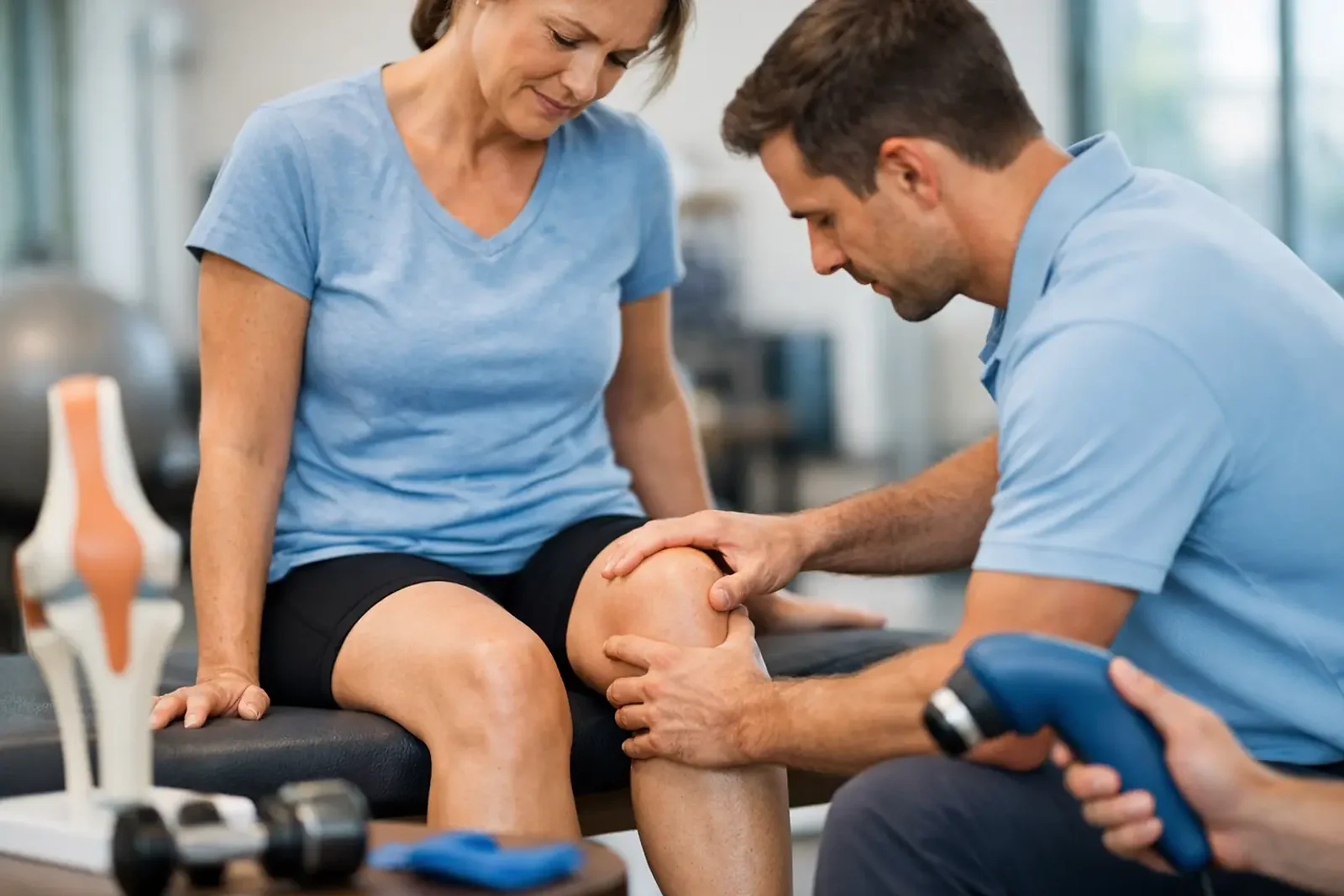
Knee pain disrupts daily activities quickly — from stairs and running to simple movements like getting off the sofa. Effective physiotherapy addresses the root causes rather than just the symptoms. Because knee pain stems from a wide range of underlying conditions, personalised assessment matters far more than any generic exercise programme.
Why knees become painful
The knee sits between the hip and the foot, so dysfunction elsewhere often shows up here. Pain can come from local irritation around the kneecap, ligament strains, meniscal injuries, or tendon overload. Osteoarthritis, post-surgical weakness, or lost confidence after a previous injury also contribute.
The way pain starts varies too — a sudden twist on a football pitch is a different problem from a gradual ache that builds up after a change in training, or from a long period of inactivity followed by a burst of intense activity. The same complaint, like pain on the stairs, can mean very different things in different people: patellofemoral pain, tendon issues, hip and thigh weakness, stiffness, or simply poor load tolerance.
What physiotherapy for knee pain involves
Assessment starts with a detailed conversation covering pain onset, location, aggravating factors, swelling, and functional impact. Physical evaluation extends well beyond the knee itself — walking patterns, squat mechanics, balance, hip control, ankle mobility, strength, and range of motion all feed into the picture.
Treatment depends on what is needed at the time. That might be settling initial pain and swelling, restoring strength, rebuilding movement confidence, or progressively returning to a specific sport or activity. Manual therapy helps in the right context, but lasting improvement comes from combining symptom relief with progressive rehabilitation — strengthening, mobility, balance, and gait retraining.
Conditions that respond well to physiotherapy
Common knee problems improve with targeted intervention. Patellofemoral pain — pain around or behind the kneecap — responds well when the programme addresses strength, control, and loading rather than simply resting. Tendon pain requires carefully calibrated strengthening; not enough volume does not change the tissue, and too much can aggravate it.
Osteoarthritis benefits significantly from physiotherapy. Contrary to assumptions about arthritis requiring avoidance, complete rest increases stiffness and weakness. Proper programmes reduce pain, improve walking tolerance, and improve stability.
Physiotherapy also supports recovery from ligament sprains, meniscal irritation, and post-surgery rehab — restoring movement and strength while preventing avoidable weakness and instability.
When rest is useful and when it isn't
Early acute flare-ups benefit from reducing aggravating activity, especially with swelling and sharp pain. But "relative rest" does not mean doing nothing — it means controlled movement within sensible ranges.
For pain that has been around for weeks or months, complete rest tends to make things worse, not better. The focus shifts to graded loading: introducing appropriate movement and strengthening so the knee becomes more resilient. A personalised plan matters because online advice cannot tell you what your knee specifically needs.
Recovery timelines
There is no universal answer. Some problems settle within weeks; others — particularly long-standing pain, tendon issues, arthritis flare-ups, or post-operative rehabilitation — take longer. Recovery depends on the diagnosis, how irritable the symptoms are, how long they have been present, and what you are trying to get back to. Clarity on progress matters more than speed.
Signs an assessment is worth booking
Professional assessment becomes important when pain is affecting walking, sleep, work, exercise, or confidence. It is especially worth considering if the knee gives way, locks, stays swollen, gets progressively worse, or stops you doing normal activities. Persistent pain after rest or generic exercises usually means the approach needs refining.
What to expect from expert rehabilitation
A structured rehab plan gives a clear diagnosis, contributing factors, and the immediate priorities — while accommodating what is actually going on in your life. At Atlas Physiotherapy Clinic, treatment is tailored to the individual rather than the diagnosis label, and may involve physiotherapy, shockwave therapy, injection guidance, or post-operative support.
Effective treatment ultimately builds confidence in the knee rather than increasing caution about using it.
Written by
Connor Jayes
Chartered physiotherapist · HCPC PH110273 · Atlas Physiotherapy Clinic, Faversham