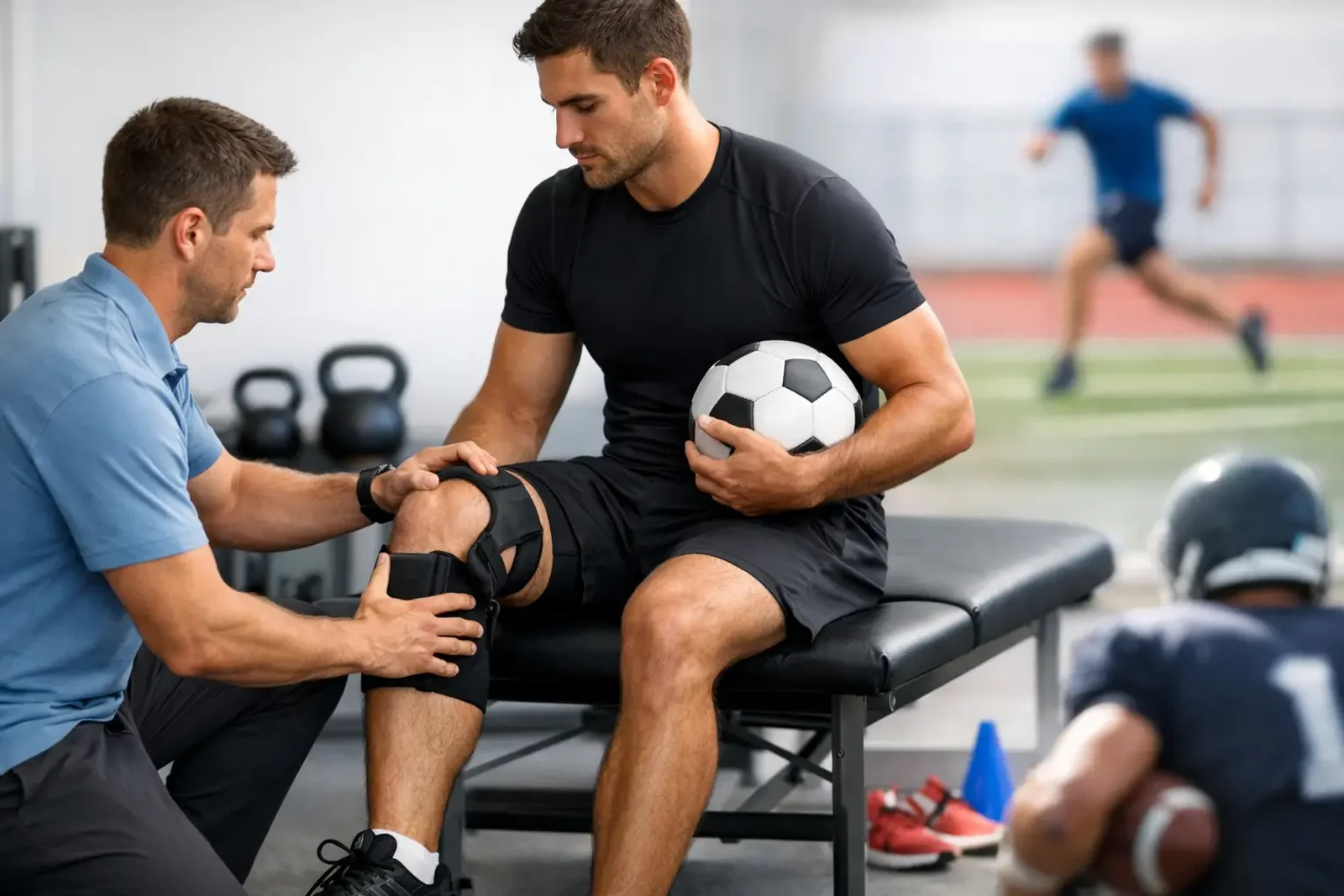
Twisting your knee in a Sunday football match or feeling a sharp pull halfway through a 10K can leave you asking the same question - when can I get back? Return to sport rehabilitation is the stage of recovery that bridges the gap between being pain-free in everyday life and being genuinely ready for training, competition and the demands of your sport.
That gap matters more than many people realise. A lot of injuries feel "better" before the body is truly prepared for sprinting, cutting, landing, tackling or repeated loading. If you go back too soon, the risk is not just a setback in the same area. You can also start moving differently, overload another joint or lose confidence in the injured body part.
What return to sport rehabilitation actually means
Return to sport rehabilitation is a structured process that prepares you for the physical and practical demands of your sport after injury, surgery or a period of enforced rest. It is not simply a few strengthening exercises and a quick check that pain has settled. It looks at whether your body can cope with speed, force, coordination, balance, impact, repetition and fatigue.
For some people, that means getting back to park run without a flare-up. For others, it means returning to tennis, CrossFit, hockey, rugby or post-operative sport with confidence. The right plan depends on your injury, your training history, your age, your sport and the standard you want to return to.
A recreational runner and a competitive footballer may both have ankle injuries, but their rehabilitation should not look identical. One may need graded loading for distance and hills. The other may need repeated acceleration, changes of direction and contact readiness. Good rehabilitation is always specific.
Why feeling better is not the same as being ready
Pain is only one part of the picture. It is perfectly possible to have low pain levels and still have reduced strength, slower reaction times, poor landing mechanics or limited tolerance to repeated effort. Those deficits often show up once intensity increases.
This is why return to sport rehabilitation usually progresses through phases. Early rehabilitation may focus on settling symptoms, restoring movement and building baseline strength. Later stages become more demanding and more sport-specific. That might include hopping, sprint drills, rotational control, single-leg strength, endurance work or movement retraining under fatigue.
Confidence also plays a big part. After an injury, many people unconsciously hold back. They avoid pushing off fully, hesitate in contact situations or struggle to trust the injured side. That is not a sign of weakness. It is a normal part of recovery, and it needs to be addressed just as seriously as strength and mobility.
The key stages in return to sport rehabilitation
Although every case is individual, most return to sport rehabilitation follows a similar path. First, the injury has to be properly assessed. That includes understanding what structure is involved, how severe the problem is, what movements provoke symptoms and what your sporting goals actually are.
The next stage is rebuilding foundations. This often involves restoring joint movement, reducing pain and swelling, and improving basic strength and control. If that stage is rushed, later progress tends to stall.
From there, rehabilitation becomes more progressive. Loads increase. Exercises become less generic and more relevant to the way you move in sport. A calf strain may move from basic heel raises to explosive push-off work and repeated running efforts. A shoulder problem may move from controlled strengthening to overhead power, control and endurance.
The final stage is return-to-performance preparation. This is where many people need more support than they expect. Being able to jog is not the same as being able to complete a full training session, recover well and repeat it later that week. This stage should test your tolerance to the real demands of sport, not just the easiest parts of it.
What is assessed during return to sport rehabilitation
A proper assessment should look beyond the site of pain. If you have had a knee injury, for example, it is often necessary to assess the hip, ankle, trunk control and overall movement pattern. The body works as a system, and compensations are common.
Clinically, your physiotherapist may assess strength, balance, range of movement, power, control, running mechanics, jumping and landing, and how symptoms behave during and after loading. Previous injuries, training volume, footwear, recovery habits and work demands can all influence the plan.
This is where expert assessment makes a real difference. Generic rehabilitation sheets can be useful in some cases, but they do not tell you whether you are underloading, overloading or missing a key weakness. A personalised treatment plan gives you a clearer route back, with realistic goals and progression points.
Common mistakes that delay a safe return
One of the most common problems is using pain alone as the green light to return. If symptoms are calm, people naturally assume they are ready. But tissues may still have reduced capacity, especially after tendon injuries, ligament sprains, muscle tears or surgery.
Another issue is doing too much too soon once things start improving. A classic example is going from no running to a full 5K, or from rehab exercises straight back into a competitive match. The body usually responds better to graded exposure than sudden spikes in activity.
Some people go the other way and stay in the "safe" stage for too long. They keep doing basic exercises but never progress to impact, speed or sport-specific demands. That can leave them technically recovered, but not practically prepared.
There is also the question of timing. Return to sport rehabilitation is rarely linear. You may progress well for two weeks, then have a flare-up after poor sleep, extra walking, a hard gym session or a busy week at work. That does not always mean damage. Sometimes it means the programme needs adjusting rather than abandoning.
Return to sport rehabilitation after surgery
Post-operative rehabilitation usually needs even more careful planning. Procedures involving the ACL, meniscus, Achilles tendon, rotator cuff or cartilage all come with healing timelines as well as performance goals. The challenge is balancing tissue protection with enough loading to restore strength and function.
This is where close monitoring helps. Joint swelling, stiffness, altered movement patterns and loss of confidence can all persist longer than expected if not addressed properly. A structured rehab plan should account for surgical guidance, objective progress markers and the practical demands of your chosen sport.
For many patients, the mental side of recovery becomes more noticeable after surgery. They may worry about re-injury, feel behind their usual fitness levels or become frustrated by the pace of progress. Clear explanations and regular progression can make a significant difference here.
Why sport-specific rehab matters
Sport places very different demands on the body. A golfer needs rotational control and repeated loading through the trunk and hips. A runner needs impact tolerance, calf capacity and efficient mechanics over time. A tennis player needs acceleration, deceleration, overhead control and repeated directional changes.
That is why return to sport rehabilitation should reflect what you actually want to get back to. It should also reflect your level. Returning to weekly five-a-side is different from returning to club rugby or marathon training. Neither is more important than the other, but the load profile is not the same.
At Atlas Physiotherapy Clinic, this kind of personalised planning is central to treatment. The aim is not just to help symptoms settle, but to make sure you understand what your body needs in order to return safely and perform with confidence.
When should you start?
Earlier than many people think. Return to sport rehabilitation does not only begin when pain has gone. The process starts from the first assessment, because early decisions influence later outcomes. Getting the diagnosis right, setting expectations and building the right foundations can save weeks of frustration further down the line.
If you are already back in training but not feeling right, it is still worth seeking help. Ongoing pain, reduced power, repeated niggles or lack of trust in the injured area are signs that recovery may be incomplete. The aim is not to scare you away from sport. It is to give you a clearer and safer route back to it.
A good rehabilitation plan should leave you knowing what stage you are in, what you are working towards and what needs to happen next. That clarity often reduces anxiety as much as it improves physical recovery.
Getting back to sport is not simply about waiting for pain to disappear. It is about rebuilding the capacity, control and confidence your sport demands, so when you return, you are not just back - you are ready.
Written by
Connor Jayes
Chartered physiotherapist · HCPC PH110273 · Atlas Physiotherapy Clinic, Faversham