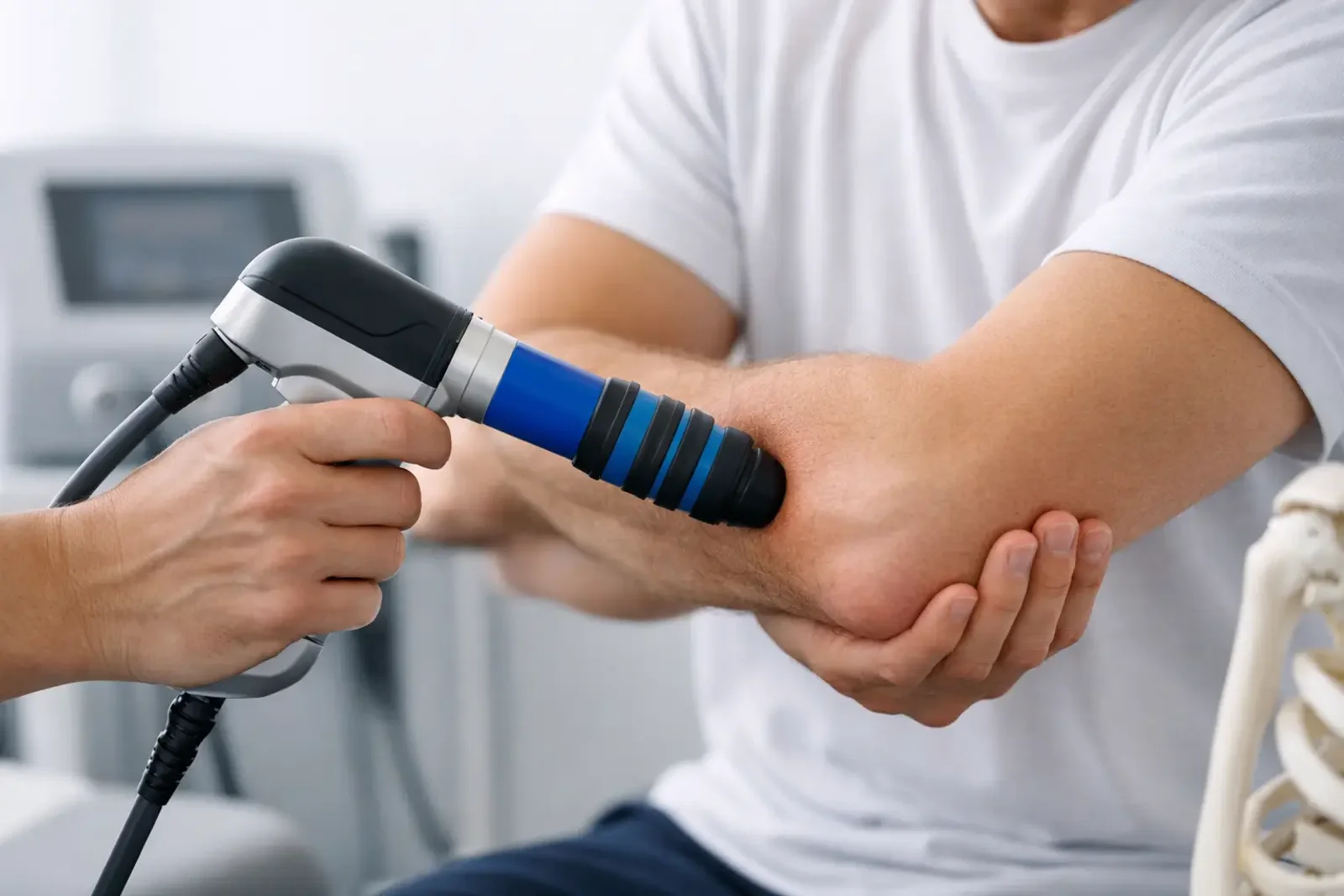
That sharp ache on the outside of the elbow often starts small. You notice it when lifting the kettle, gripping a steering wheel or shaking hands, then suddenly simple jobs become irritatingly painful. Shockwave therapy for tennis elbow is one option we often discuss when symptoms have settled in and are not improving with rest alone.
Tennis elbow, also called lateral elbow tendinopathy, is not just a sports injury. Many people who develop it have never picked up a racket. It is common in people whose work or hobbies involve repeated gripping, lifting, twisting or wrist extension. Gym training, DIY, gardening, childcare, office work and manual jobs can all play a part.
What is tennis elbow really?
Despite the name, tennis elbow is usually a tendon problem rather than a joint problem. The pain tends to sit around the bony point on the outer part of the elbow where the forearm tendons attach. Over time, repeated strain can leave this area irritated, painful and less able to cope with load.
That matters because the right treatment is not usually complete rest. Tendons generally respond better to the right amount of load, introduced at the right time, than to doing nothing for weeks and hoping for the best. The challenge is working out what stage your symptoms are at and what your tendon can currently tolerate.
Some people have a fairly recent flare-up linked to a clear increase in activity. Others have pain that has been nagging for months, with reduced grip strength and discomfort during both work and exercise. These cases often need a more structured plan.
How shockwave therapy for tennis elbow works
Shockwave therapy uses acoustic waves delivered to the painful tendon area through a handheld device. It is a non-surgical treatment commonly used for persistent tendon pain, particularly when symptoms have not responded fully to exercises, activity changes or other conservative treatment.
The exact mechanism is still being studied, but clinically we use shockwave to stimulate a healing response in tissues that have become stubborn and slow to settle. It may help improve local blood flow, influence pain signalling and encourage tendon remodelling. In plain English, it is aimed at nudging an irritated, underperforming tendon to start responding more normally again.
It is not a magic fix and it is not suitable for every elbow pain presentation. If your symptoms are actually coming from the neck, the radial nerve, the joint itself or a different tendon problem, shockwave is unlikely to be the main answer. That is why expert assessment comes first.
When it may be a good option
Shockwave therapy is usually considered when tennis elbow has become persistent, often lasting several weeks or months, and is limiting day-to-day function. It can be particularly helpful for people who have already tried relative rest, pain relief, support straps or general exercises without making meaningful progress.
It may suit you if gripping is painful, lifting is difficult, work tasks keep flaring it up or your sport has stalled because the elbow simply does not tolerate loading. It can also be useful when the goal is to avoid more invasive treatment and there is a clear tendon-based pattern on assessment.
That said, timing matters. In a very irritable early flare-up, the first priority may be to calm symptoms, adjust aggravating activities and begin appropriate loading. In longer-standing cases, shockwave may fit more naturally into the treatment plan.
What happens during treatment?
A proper appointment should not begin with the machine. It should begin with questions about your pain, work, sport, symptoms, aggravating tasks and previous treatment. The elbow, wrist, shoulder and sometimes neck should be assessed to confirm the diagnosis and rule out other causes.
If shockwave is appropriate, gel is applied to the skin and the treatment head is placed over the affected area. The machine delivers a series of pulses into the tendon attachment. Most people describe it as uncomfortable rather than unbearable. The sensation can be sharp over tender spots, but it is quick and usually manageable.
Sessions are short, often around five to ten minutes of actual shockwave treatment, though the full appointment is longer because treatment should sit within a broader rehabilitation plan. You may have some temporary soreness afterwards, similar to a flare-up, but this usually settles.
How many sessions do you need?
A typical course is often three sessions spaced about a week apart, although the exact number can vary depending on the severity and duration of symptoms. Some people notice change after the first session. Others improve more gradually over several weeks.
This is one of the most important expectations to get right. Shockwave is not usually about walking out pain-free on the day. Tendons tend to improve over time, especially when shockwave is combined with the right exercises and a sensible plan for returning to loading.
If someone is expecting an instant fix, they may be disappointed. If they understand that the aim is to create the conditions for longer-term improvement, the treatment makes much more sense.
Shockwave works best as part of a plan
For most cases of tennis elbow, treatment should not stop at shockwave. The tendon still needs help regaining strength and tolerance. That is where physiotherapy plays a central role.
A personalised programme may include isometric exercises for pain relief, progressive wrist extensor strengthening, grip work, shoulder control exercises and advice on how to modify aggravating tasks without stopping everything. If your work involves repetitive lifting or your sport involves repeated backhands, serving or pulling movements, your plan should reflect that.
This matters because pain reduction alone is not enough. If the tendon remains weak or overloaded, symptoms often return as soon as normal activity resumes. Good rehab bridges the gap between feeling better and staying better.
Does shockwave therapy for tennis elbow actually help?
The honest answer is that it depends on the individual case. Research on shockwave for tennis elbow shows mixed but generally encouraging results, particularly for persistent cases. In clinic, some patients respond very well, especially when the diagnosis is clear and treatment is paired with targeted rehabilitation.
Others improve only modestly, or need a different route. That does not mean the treatment has failed. It may mean the main driver of pain is different from what was first assumed, or that work demands, tendon irritability, sleep, recovery or exercise adherence are slowing progress.
Good care means being clear about this from the start. A specialist should explain where shockwave fits, what it can and cannot do, and what the alternatives are if progress is limited.
When shockwave may not be suitable
There are situations where shockwave is not advised. These can include certain medical conditions, clotting disorders, local infection, pregnancy in some treatment areas, or if the diagnosis is uncertain. It may also not be the first choice if symptoms are coming from a trapped nerve, significant joint pathology or referred pain from the neck.
Previous injections can also influence decision-making. Steroid injections may reduce pain short term for some people, but they are not always the best long-term tendon strategy. If you have had an injection already, the wider plan needs to take that into account.
This is why a one-size-fits-all approach rarely works well with elbow pain. The treatment has to match the tissue, the stage of symptoms and the demands of your life.
What recovery looks like in real life
Recovery is rarely a straight line. Most people can keep doing some normal activities during treatment, but the aim is to reduce unnecessary aggravation while building capacity back up. That might mean changing how you lift at work, adjusting gym exercises, easing back on repetitive gripping or temporarily reducing racquet sport.
You should also expect the plan to evolve. Early on, the focus may be pain management and settling irritability. Later, it shifts towards strength, endurance and return to full function. If you are a keen golfer, a parent lifting children, or someone who uses tools all day, those goals should be built into your rehab rather than treated as an afterthought.
At Atlas Physiotherapy Clinic, that is exactly how we approach persistent tendon pain - with expert assessment, personalised treatment plans and clear advice that fits real life.
If your elbow has been lingering longer than it should, and you are tired of avoiding the things that set it off, the next step is not guessing. It is finding out exactly what is driving the pain and whether the right combination of shockwave, rehabilitation and hands-on guidance can move things forward.
Written by
Connor Jayes
Chartered physiotherapist · HCPC PH110273 · Atlas Physiotherapy Clinic, Faversham